The journal

How the game works, written out

Straight answers about the draw, the odds and your money — from the people who built it. No tips, no systems, no lucky numbers.

How to play6 min read

Straight or Box: which ticket is actually right for you?

One covers a single number. The other covers up to 24, and costs up to 24 times as much. The choice is not about luck, it is about arithmetic.

Read the article

The two tickets, in one paragraph

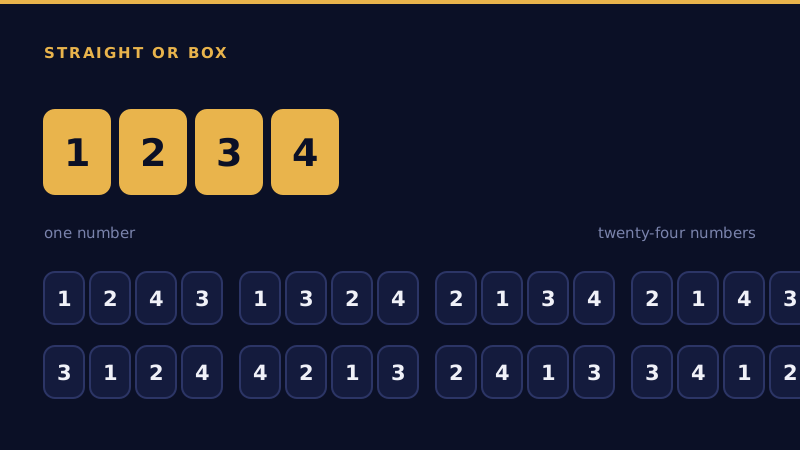
A Straight ticket wins only if the draw produces your exact number. A Box ticket covers every arrangement of your four digits, so 1234 Box holds 1234, 1243, 1324, 1342 and twenty more. You are not getting those extra numbers free: you pay your stake on each one. At 1.00 USDT a number, a 24-way Box costs 24.00.

How many arrangements you actually get

It depends entirely on repeated digits. Four different digits give 24 arrangements. One pair gives 12. Two pairs give 6. Three of a kind gives 4. And four of a kind gives exactly one, which is why 8888 Box costs the same as 8888 Straight and the quote panel says so before you buy.

The trade nobody explains

Box multiplies your chance of hitting and multiplies your cost by the same amount. Twenty-four arrangements at 1.00 each is twenty-four chances for 24.00 - arithmetically identical to twenty-four separate Straight tickets. What Box buys you is not better odds, it is convenience and a different shape of outcome: more small wins instead of one rare large one.

When each makes sense

Straight if you are attached to a specific number - a date, a plate, something you would be sick to see come out in the wrong order. Box if you care about the digits rather than their order, and you would rather hit more often for less each time. Neither is cleverer. They are different bets on the same draw.
8 September 2026
The game4 min read

What Luck By Chance is, and why we added it

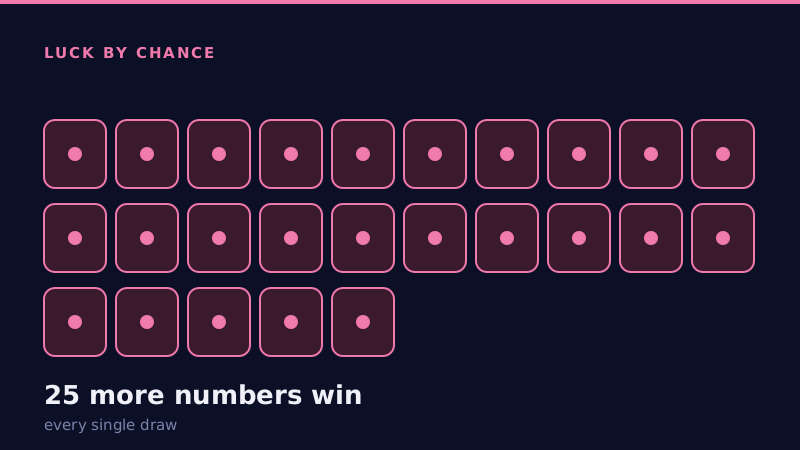
Twenty-five extra numbers a draw, paying 100×. It exists because a board with three big prizes and twenty middling ones leaves too many tickets holding nothing.

Read the article

The problem it solves

Before it existed a draw produced 23 winning numbers out of 10,000. That is a 1 in 435 chance that any given number wins something at all. Most draws, for most players, produced nothing - and a game where nothing happens for weeks is not a game anyone stays with.

What it does

Luck By Chance adds 25 numbers, drawn alongside the others and paying 100x your stake. It takes the board from 23 winning numbers to 48, which moves the odds of a given number taking some prize from 1 in 435 to about 1 in 209. Slightly better than doubled.

It is a real tier, not a gimmick

The numbers are drawn with the rest, entered by the same operator, verified by the same second person, and settled in the same pipeline. It is not a raffle bolted on the side, and it is not decided after the fact. It is twenty-five more winning numbers, no different in kind from Special or Consolation.

How it appears

On the results board it has its own column and its own colour, so you can see at a glance whether your number landed there. In the archive it is counted separately, so searching a number tells you how many times it has come out in each tier.

5 September 2026
Fairness5 min read

Two people sign every draw before anyone is paid

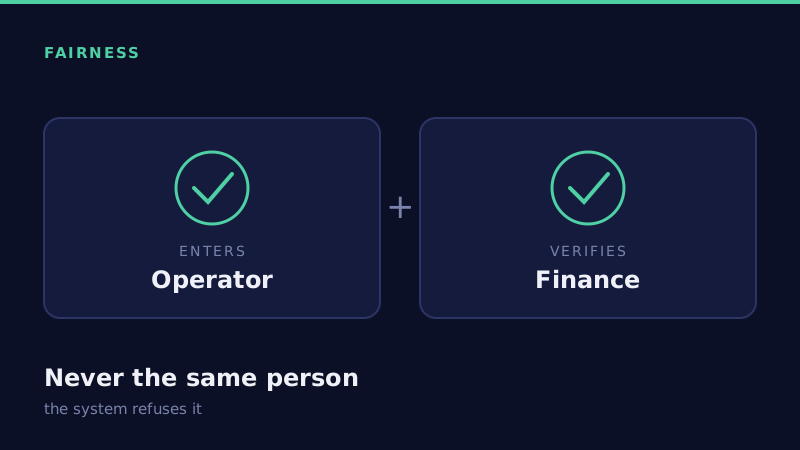
The person who types the winning numbers is never the person who approves them. That is not policy — the system physically refuses.

Read the article
2 September 2026
How to play4 min read

How to read a 4DLD results board

Forty-eight numbers, four tiers, one draw. Here is what each block means and where to look first.

Read the article

The top row

Three numbers: 1st, 2nd and 3rd prize, paying 3,500x, 2,000x and 1,000x your stake. First prize is set in gold and larger than the others because it is the one everyone checks first.

The three columns underneath

Special holds 10 numbers at 500x. Consolation holds 10 at 200x. Luck By Chance holds 25 at 100x. They are laid out as three columns of exactly five rows each - Special and Consolation two numbers wide, Luck By Chance five - so the whole lower board reads as one block instead of three stacked lists.

What the header tells you

Draw number and year, in the form 405/26. The date with the day of the week. The draw time, always 11:11 UTC. And a status - a settled draw has been verified and paid.

The rule that catches people out

No number appears twice in the same draw. All 48 are different. Across draws there is no such rule: a number can come out three times in a month and then not at all for a year. Nothing carries over and no number is ever due.

29 August 2026
The game5 min read

Why a number is never “due”

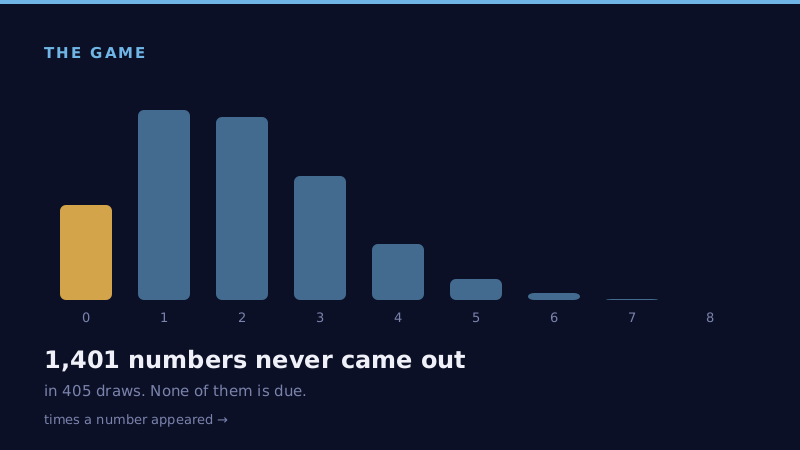
In 405 draws, 1,401 numbers have never come out once. That does not make any of them more likely tomorrow.

Read the article

The instinct

A number has not appeared in fourteen months. It feels overdue - as though the draw owes it an appearance and the debt is growing. This instinct is strong, it is universal, and it is wrong.

What the archive actually shows

Across 405 draws there are 19,440 winning slots spread over 10,000 numbers, so any given number should appear about twice. And it works out almost exactly like that: roughly 1,400 numbers have never appeared, about 2,800 appeared once, about 2,700 twice, and a handful appeared eight times. That spread is not a pattern. It is what happens when you draw at random 19,440 times.

Why the draw has no memory

Each draw is generated independently. The machine has no record of what came out yesterday and no mechanism to favour a number that is behind. A number that has been absent for a year has exactly the same chance tonight as one that came out this morning: 48 in 10,000 of taking some prize.

The useful version of this idea

History is worth reading - it tells you what has happened, and it is the strongest evidence that the draw is honest. It is not a forecast. Anyone selling you a system built on overdue numbers is selling you the feeling, not the mathematics.

24 August 2026
Your money4 min read

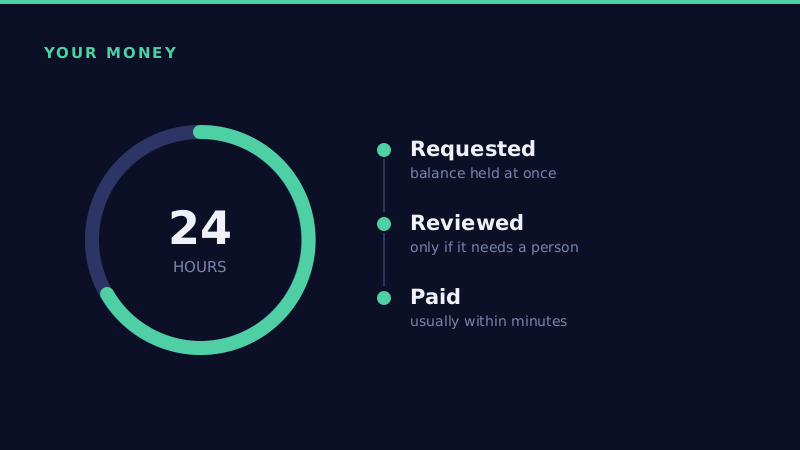
What happens in the 24 hours after you request a withdrawal

Most go out in minutes. Here is the whole path, including the checks that occasionally add time and why they exist.

Read the article

The moment you press withdraw

Your balance is debited immediately and the amount is held. This matters: it means the money cannot be staked while the withdrawal is pending, so there is no window where the same funds exist twice.

The automatic path

Most withdrawals need no human at all. If the amount is under the review threshold, the destination address is one you have used before, and nothing in your account pattern is flagged, it goes to the payout queue and out on chain.

When a person looks

Three things bring in a reviewer: an amount over the threshold, an address added in the last 24 hours, or a pattern our monitoring flags. New addresses are always held for a day - if someone ever gets into your account, that delay is what stops them emptying it to their own wallet before you notice.

The promise, and what it means

Paid within 24 hours of the request. That is the outer bound, not the target - most are far quicker. If a payment is held longer than a day you are told why and when to expect it, rather than being left watching an empty screen.

19 August 2026